
While markets panic about AI "bubble collapse," smart executives are quietly building competitive moats. The infamous 95% AI failure rate that spooked Wall Street isn't revealing technology limitations. It's exposing which companies understand implementation and which are burning money on shiny objects. Here's what the hysteria is missing: those failure rates create massive opportunity for leaders who know the real game isn't about better algorithms, it's about better change management.
And like any maturing market, the winners are separating from the pretenders based on execution, not hype.
The flawed study everyone's citing
The 95% failure rate comes from MIT's NANDA initiative, which defined success so narrowly that even profitable AI implementations got labeled "failures." They used old-school, single-dimension ROI thinking, requiring measurable financial returns within six months while completely ignoring efficiency gains, cost reductions, employee satisfaction improvements, and strategic advantages. This is exactly the outdated approach that misses most of AI's actual value. Real AI ROI requires a 360-degree view: direct financial returns, operational improvements, and strategic competitive advantages. More telling: their "zero return" conclusion was based on just 52 interviews that researchers admitted were only "directionally accurate."
Meanwhile, the real data tells a different story. McKinsey found 92% of executives plan to increase AI investments. Stanford's AI Index shows 78% of organizations used AI in 2024, up from 55% in 2023. Big Tech just committed $364 billion for 2025 AI investments.
That's not bubble behavior. That's strategic commitment from people who know what's actually working.
What's really killing AI projects
Here's the dirty secret: 70% of AI failures come from people and process problems, not technology. Companies keep throwing money at algorithms when the real issue is change management.
The pattern is predictable. Organizations buy AI tools, dump them on employees with minimal training, expect immediate results, then wonder why adoption stalls. They focus on features instead of workflows. They optimize for impressive demos instead of daily usability.
MIT's research confirms this "learning gap"—the disconnect between AI capabilities and organizational workflows. Generic tools work great for individuals but fail in companies because they don't integrate with existing processes or decision-making structures.
The companies succeeding with AI aren't the ones with the fanciest models. They're the ones treating AI deployment as organizational transformation.
The human-centered advantage
Smart companies flip the traditional approach. Instead of starting with technology, they start with people. Instead of replacing human judgment, they augment it. Instead of mandating tools, they solve problems employees actually care about.
DBS Bank deployed 800+ AI models with expected economic impact exceeding $1 billion. Their secret? They positioned AI as human capability enhancement, not replacement. Morgan Stanley achieved 98.5% adoption of their AI assistant because they focused on comprehensive training and user buy-in.
The difference isn't technical sophistication—it's implementation sophistication.
Tool-pushers versus problem-solvers
Companies pushing "tools for tools' sake" follow predictable failure patterns. They implement without redesigning processes. They over-automate without human oversight. They measure technical performance instead of business outcomes.
IBM Watson Health's $62 million oncology failure exemplifies this approach. Brilliant technology, terrible implementation. They focused on AI capabilities without understanding clinical workflows or physician needs.
Contrast that with H&M, who positioned AI as "amplified intelligence" to enhance human creativity. Result: high adoption rates and measurably improved stock efficiency. Same with Rolls-Royce, who used AI analytics to predict implementation resistance and address it proactively.
The companies winning aren't buying better AI. They're building better change management.
What successful AI adoption actually looks like
The winners share common characteristics. They start with clear business problems, not cool technology. They invest equally in change management and technical implementation. They maintain human control over critical decisions. They build trust through transparency and consistent performance.
Most importantly, they treat AI implementation as a marathon, not a sprint. They build organizational capabilities for continuous learning and adaptation. They create cultures that embrace experimentation and human-AI partnership.
The maturation opportunity
While others panic about failure rates, smart executives are building AI capabilities that compound over time.
The research shows a clear pattern: organizations approaching AI as primarily a technology problem join the 70-95% failure statistics. Those treating it as holistic transformation, addressing strategy, culture, and human factors with equal rigor, consistently deliver measurable business value.
The choice isn't whether to pursue AI. It's how to pursue it strategically. The companies that master human-centered implementation while others chase algorithmic perfection will capture the transformative value that justifies continued investment.
The 95% aren't failing because AI doesn't work. They're failing because they don't understand that successful AI transformation starts with understanding people, not just technology.
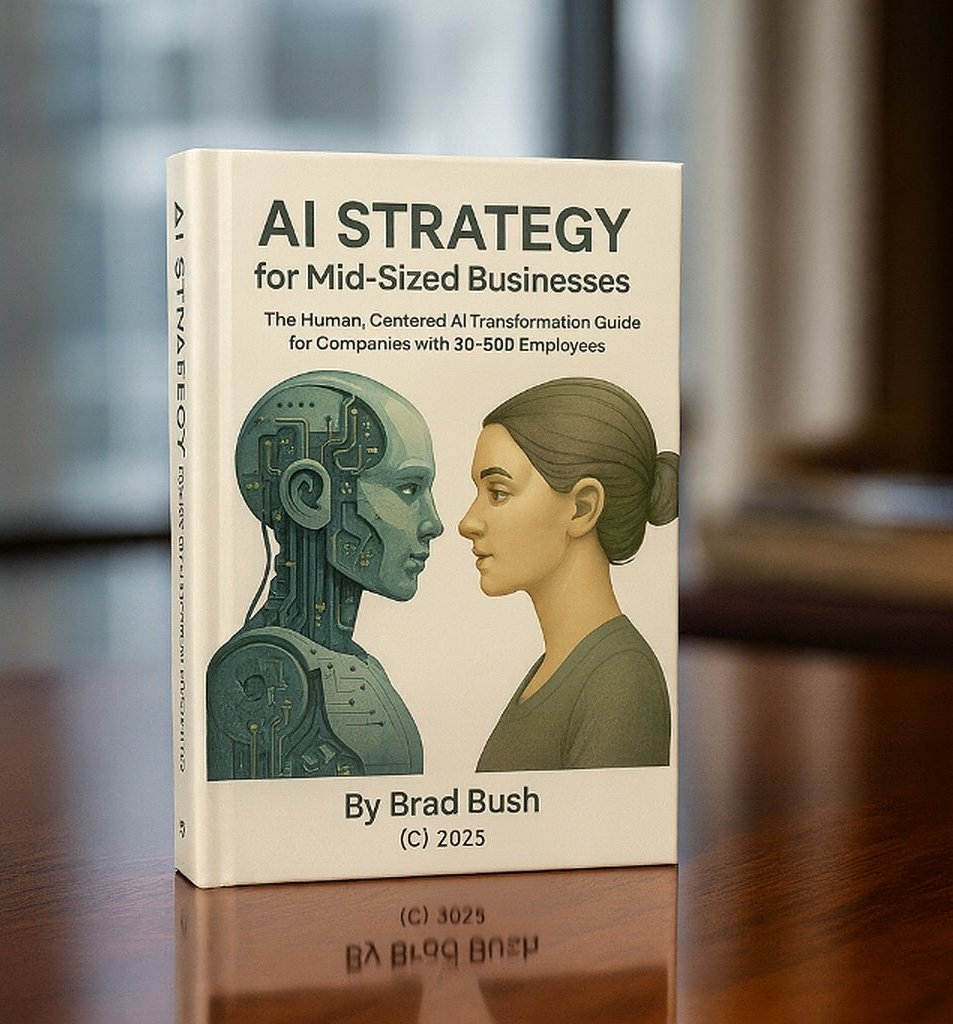
For more insights on human-centered AI implementation strategies download "AI Strategy for Mid-Sized Businesses" here in the book
Originally published by Brad Bush on LinkedIn.
Want a copy to keep or share?
Get this essay as a PDF you can save or send to colleagues.