In 2005, a chess experiment changed how we think about human-machine collaboration.
Garry Kasparov, the greatest chess player of his era, had lost to IBM's Deep Blue in 1997. Most assumed the lesson was clear: machines beat humans. Game over.
Kasparov saw something different. He organized "freestyle" chess tournaments where any combination of human and computer was allowed. The results surprised everyone.
The winners weren't the strongest computers. They weren't the grandmasters with computer assistance. They were amateur players using multiple AI programs, coordinating their outputs, and applying human judgment to choose between recommendations.
Kasparov called this the "centaur" model: human intuition guiding machine calculation.
Twenty years later, that model is transforming professional services.
The 69% Signal
OpenAI's State of Enterprise AI 2025 report surveyed 500 enterprise leaders. The headline finding aligns with what Kasparov discovered in chess:
69% now cite Employee Productivity as their top AI driver. Cost Reduction trails at 47%.
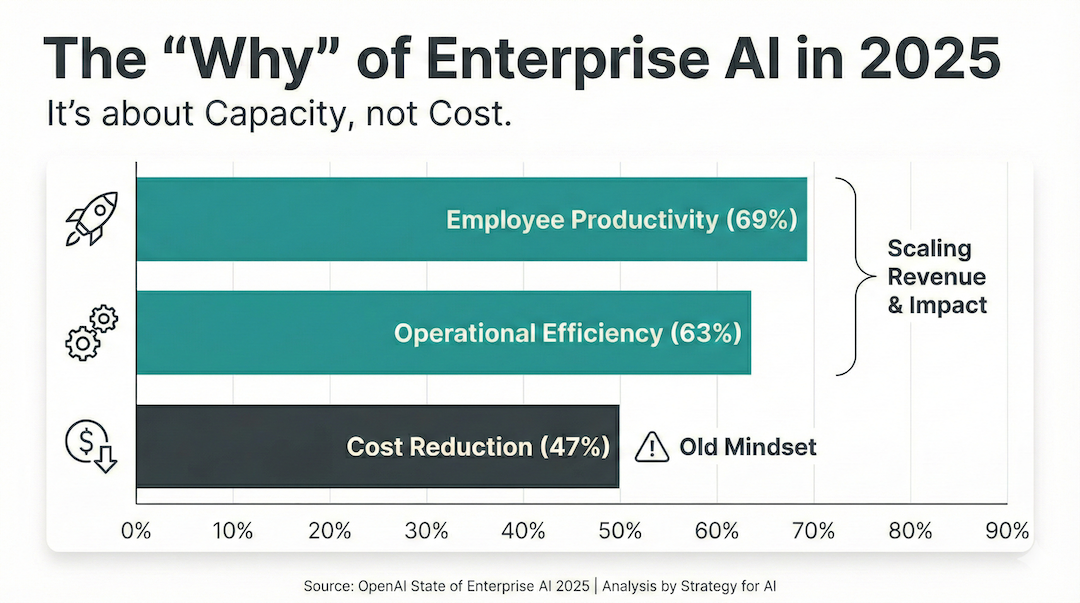
Enterprises aren't using AI to replace human workers. They're using it to amplify what human workers can do.
This isn't a subtle distinction. It's a 22-point gap in strategic priority, the difference between seeing AI as a knife and seeing it as a lever.
Why the "Replace Humans" Narrative Failed
For three years, the dominant AI story was automation: identify tasks, train models, eliminate headcount, cut costs.
That narrative crashed into reality.
Formatting documents? AI handles it. Extracting data from PDFs? AI handles it. Generating first drafts? AI handles it.
But advising a client through a complex negotiation? Understanding the political dynamics in a boardroom? Knowing which question to ask when the numbers don't add up?
That's human work. And it's the work clients actually pay premium rates for.
The firms that tried to cut costs by replacing professionals discovered something uncomfortable: the automation savings were small, and the client relationships suffered.
The firms that multiplied their professionals, giving each one AI leverage across research, synthesis, and routine tasks, are pulling ahead.
The Centaur Model for Professional Services
The chess lesson applies directly to CPAs, lawyers, engineers, and consultants:
Human + AI instead of AI vs. Human
A centaur firm looks different from a traditional firm:
Partners spend less time reviewing documents and more time advising clients. AI handles the first pass. Humans handle the judgment calls.
Associates multiply their output without multiplying their hours. Research that took days compresses to hours. The associate's job shifts from gathering information to interpreting it.
The unbillable drudgery disappears. Data entry, formatting, compliance checklists, report generation (the tasks that consumed 30-40% of every professional's week) get automated. That time flows to billable work or business development.
Capacity grows without headcount. A 15-person firm delivers what used to require 25 people. Not by working harder, by working differently.
The Three-Champion Model
After implementing AI across multiple professional services firms, I've found the centaur model works best with three champions, not one:
The Technical Champion: Understands the AI tools, manages integrations, solves workflow problems. Usually a senior associate or operations lead.
The Business Champion: Owns the business case, which processes to automate first, how to measure ROI, when to expand. Usually a partner or COO.
The Culture Champion: Manages change, addresses fear, celebrates wins, reframes the narrative from "AI threatens my job" to "AI upgrades my job." Usually a respected professional who's genuinely excited about the shift.
One champion creates a pilot. Three champions create adoption.
The Agentic Leap
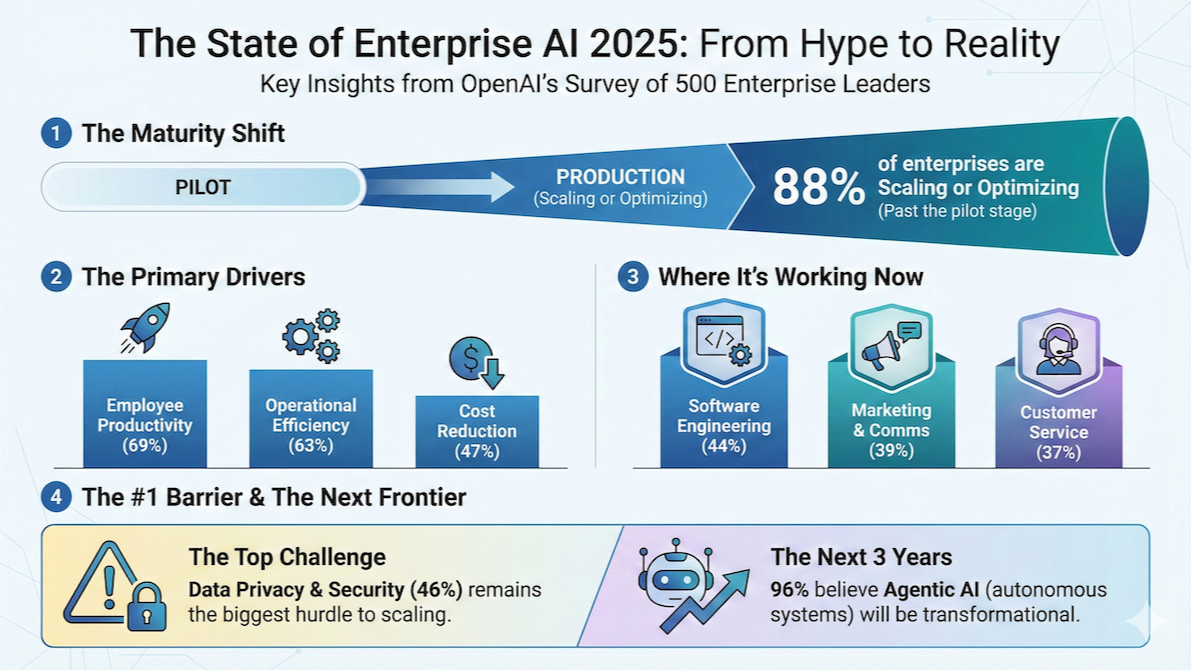
The OpenAI report points to what's coming: 96% of leaders believe Agentic AI will be transformational within three years.
Agentic AI moves beyond the chat interface. Instead of waiting for a human to ask a question, it takes autonomous action: monitors deadlines, triggers workflows, assembles documents, escalates exceptions.
For the centaur model, this changes the partnership:
A client engagement that once required 40 hours of associate time (intake, research, drafting, review, delivery) might require 15 hours of human oversight while AI handles the connective tissue. The remaining time can be spent on better client and peer communications, and strategic and creative work. The kind of work that elevates not depresses employees.
The human role elevates. The throughput multiplies.
The Trust Barrier
One finding from the OpenAI report deserves attention: Data Privacy and Security remains the #1 deployment barrier at 46%.
Centaur firms don't ignore this concern. They solve it first.
Before scaling AI across client work, they establish clear policies: what data goes into which tools, how outputs are reviewed, where human oversight is required, how client confidentiality is protected.
Governance isn't the enemy of adoption. It's the foundation.
The Bottom Line
Kasparov lost to Deep Blue in 1997. A decade later, amateur humans with AI beat both grandmasters and supercomputers.
Professional services firms face the same fork:
Path A: Compete as humans alone. Watch AI-augmented competitors deliver more, faster, at higher margins.
Path B: Build a centaur firm. Combine human judgment with AI leverage. Multiply your capacity without multiplying your headcount.
88% of enterprises have moved past the pilot stage. The centaur race has started.
The question is whether your firm is running or watching from the sidelines.
📊 Full report: https://cdn.openai.com/pdf/7ef17d82-96bf-4dd1-9df2-228f7f377a29/the-state-of-enterprise-ai_2025-report.pdf
Originally published by Brad Bush on LinkedIn.
Want a copy to keep or share?
Get this essay as a PDF you can save or send to colleagues.