
A founder of a CPA firm called me this spring. Forty people. A good year behind him and a better one planned. Then a client he had held for a decade moved its tax and advisory work to a firm half his size. Same quality. Faster turnaround. A fee he could not match without losing money on the work. He asked the client what had changed. The client said the other firm was just quicker, and the partner over there seemed to have more time for him. The details here are a blend of firms I have talked with (to protect the innocent), but the pattern is not.
Here is what I told him. Nobody was going to announce it. There was nothing to announce. No press release, no award, no new logo on the door. The other firm has rebuilt their workflows on AI, probably intake or reporting. This allows people to spend their hours on judgment instead of keystrokes. It looks like nothing from the outside, but from the inside it creates competitiveness that allows these firms to win the work.
Why you cannot see the gap
Firms do not publish their internal hours. You will never see a competitor's timesheet, so you never see the advantage directly. You see it second-hand, in places that look like ordinary business problems.
You lose a bid on speed, not price. Your margin drifts while revenue holds. Headcount grows faster than revenue. A senior person is still doing junior work at eleven at night because the grunt work never shrinks. Each of these has an innocent explanation, and firms reach for the innocent explanation every time. They ignore the gap around rethinking how their work gets done.
Think of it as a current that you are swimming against. You do not feel a current while you are in the water. You notice it when you look up and the shore is a half mile away.
Everyone is using it. Almost nobody is gaining from it.
Here is the thing that surprised me most when I dug into the research (while working on my next book). The gap is not between firms that use AI and firms that do not. Nearly everyone is using it. The gap is between firms that use it and firms that have rebuilt a process around it. That second group is rather small.
By late 2024, nearly 40 percent of working-age Americans had tried generative AI, and about one in four employed people had used it for work in the previous week, according to a National Bureau of Economic Research study by Bick, Blandin and Deming. Individual reach came faster than the personal computer did. Firms are a different story. The Census Bureau's 2026 business survey found that 18 percent of U.S. firms had recently used AI, and most of those used it in three or fewer functions. Broad, and shallow.
Then the number I keep coming back to. A 2026 survey of nearly 6,000 senior executives across four countries, also published by NBER, found 69 percent of their firms actively using AI. Eighty-nine percent said it had made no difference to labor productivity so far. PwC's CEO survey in January 2026 asked 4,454 chief executives what AI had done for them in the past year. Fifty-six percent said neither higher revenue nor lower costs. Twelve percent said both.
Read that as a firm owner. Seven in ten firms have the tools, but only one in eight is getting a return on investment in AI. That is another externally invisible gap. Both groups have a partner who uses ChatGPT. Only one has changed how the work actually gets done.
What the one in eight did differently
Where there is real measured gain, all of the examples are similar. They all rebuild a single process with the people in the business that are responsible for that process, and they attach an ROI.
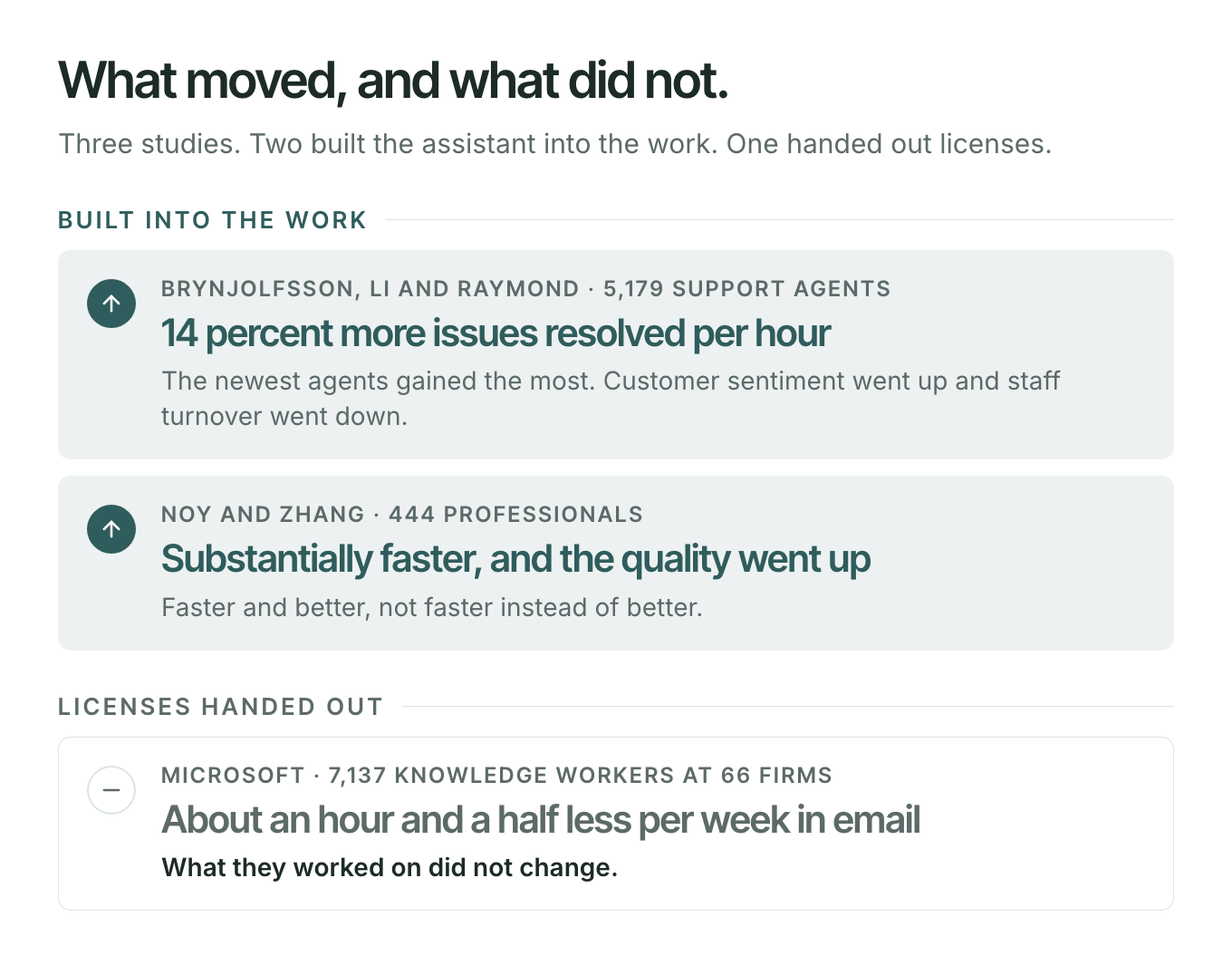
The best known is Brynjolfsson, Li and Raymond's study of 5,179 customer support agents at one firm, published in the Quarterly Journal of Economics in 2025. With an AI assistant built into the workflow, agents resolved 14 percent more issues per hour. The newest support agents gained the most. Customer sentiment went up and staff turnover went down. A single process in a single firm is exactly the point. Nobody transformed the company. They rebuilt one workflow and measured that one workflow.
Noy and Zhang ran a controlled experiment with 444 college-educated professionals on the kind of busywork writing all firms have: memos, reports, analyses. With AI the work got done substantially faster and the quality went up at the same time. Faster and better, not faster instead of better. Again, a single process done better and measured better.
Now the other side. Microsoft researchers randomized Copilot access across 7,137 knowledge workers at 66 firms and read the telemetry. People with the tool spent about an hour and a half less per week in email. What they worked on did not change. Just giving out licenses changes minutes. It does not rebuild a process, and the process rework is the only way to get true ROI.
A Workday survey of 3,200 workers found 85 percent reported saving one to seven hours a week with AI. The people who reported a clear net gain were the ones who said the time went into deeper analysis, decisions and strategy. Others who just replaced it with other busywork had little net gain.
Why it compounds
The research measures the first productivity loop. The next productivity loops are what I see inside firms after the first.
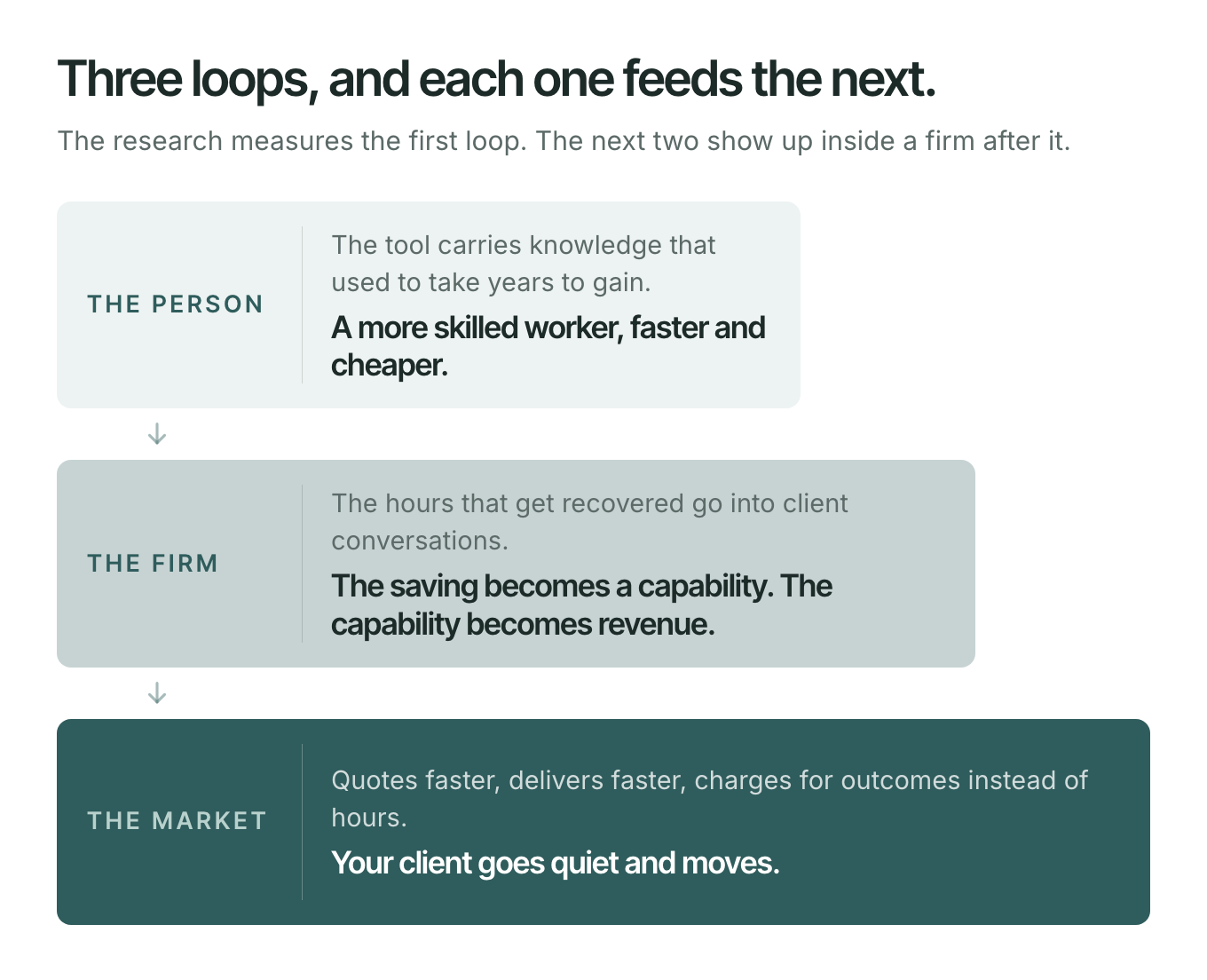
The person. In the support-agent study, the least experienced people gained the most, because the tool had the knowledge that used to take years to gain. In a CPA firm that is a second-year senior with AI built into the close process. She reaches review-level judgment sooner, and her judgment is now part of the firm's capacity. Six months in, she is using it across most of her work, and the firm did not buy anything new to get there. It got a more skilled worker, faster and cheaper.
The firm. Process changes across multiple team members change what the whole team expects. For the CPA, the intake gets rebuilt around the new pace. Close processes get a template the tools can read. The hours that get recovered go into client conversations, and the client conversations turn into new advisory work. The same support study saw the second-order effect too: customers noticed, and people stayed. The saving becomes a capability, and the capability becomes revenue.
The market. That firm now quotes faster, delivers faster and charges for outcomes instead of hours. Your client compares the two experiences and does not need a spreadsheet to decide. He just goes quiet and moves.
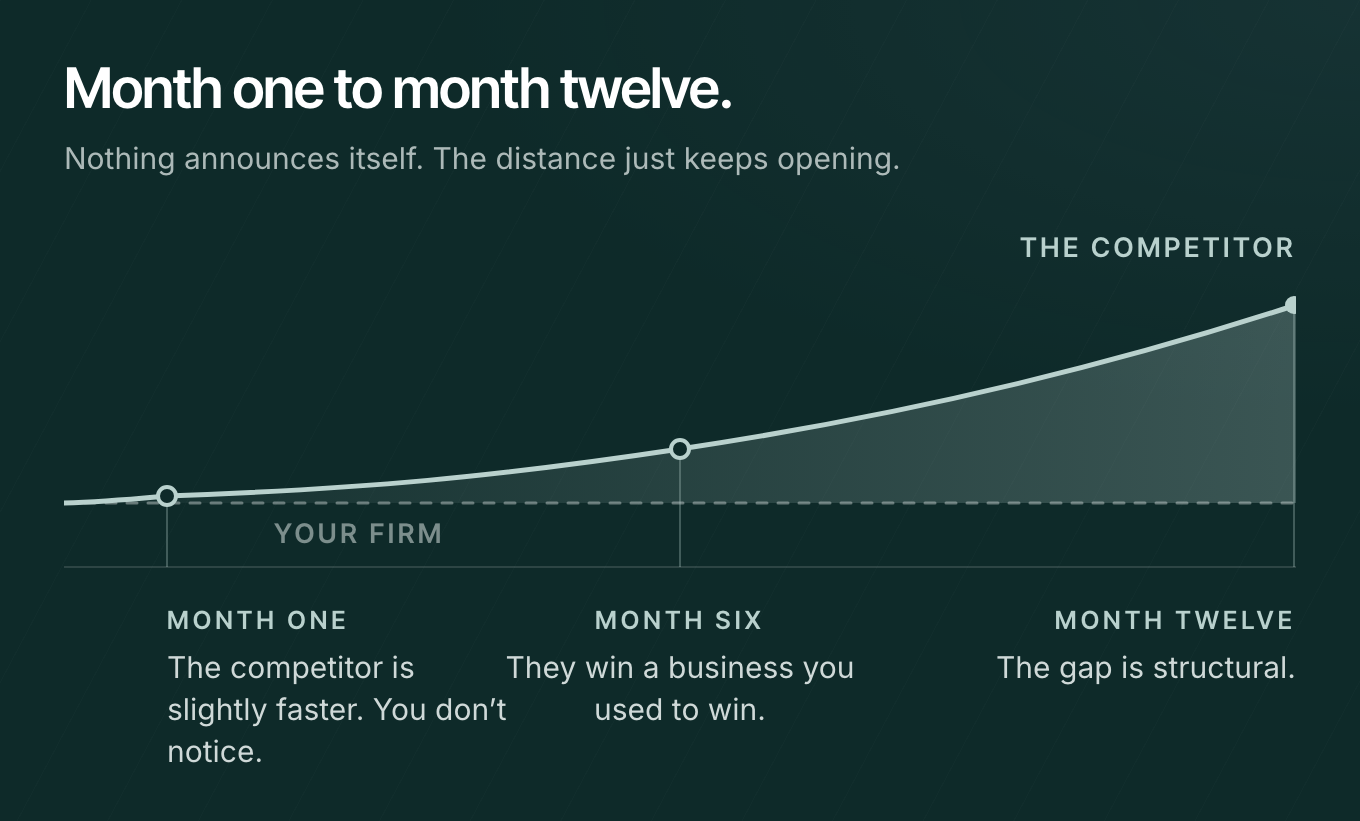
Month one, the competitor is slightly faster and you don't notice. By month six, they win a business you used to win, and you start asking why. By month twelve, the gap is structural, and the six months of learning lead their people have cannot be bought easily. That is the whole argument for starting now rather than starting well.
What the gap isn't
- It is not a software purchase. Every firm in your market can buy the same licenses tomorrow, and the numbers above say most of them already have.
- It is not a headcount cut. More than nine in ten of those 6,000 executives reported no employment changes from AI in three years, and the support-agent firm kept its people and even lost fewer of them.
- It is not a moonshot. The firms I see winning did one core process, with the people who own that process, and measured the return.
Efficiency alone can hurt a firm that bills by the hour. If you get faster and keep selling time, you just earned less. The firms getting ahead changed their business model of how they sell at the same time as they changed how they work. Faster work only pays when you price the outcome instead of the hour.
Straight answers
Are we already behind? Ask four questions tonight.
- Are you losing bids you used to win?
- Is margin tighter than it should be for the revenue?
- Is headcount growing faster than revenue?
- Are competitors moving faster with fewer people?
Do we need to hire AI people? No. The wins in a firm your size come from applying tools that already exist to work you already do. You need two of your own people who know the process and have an appetite for this. They become your champions.
What does the first project cost in time? A partner or owner sponsors it. Two champions give a few hours each week. The people who run the process give interviews early on and test the final solution. Let us do the heavy lifting on the build. That is the shape of the 90 Days to AI Payback engagement I run.
Our data is a mess. Every firm says this, and most AI vendors want you to clean everything first. That is how firms never start. The first two weeks find the one process where the data is good enough today, and you start there. Perfect data is not a prerequisite. It is a result.
Our partners will not adopt it. They will not adopt a tool someone bought for them. They adopt what their own people built and can show working on a real client file. Pick the champions from the people who feel the pain, early, and the partners follow the evidence.
What I will not do, and what I will
I will not promise a silver bullet, sell you a platform you do not need, hand you a year-long roadmap, lock you into a long engagement, or talk about AI as a way to replace your people. The more the tools do, the more your people matter, because judgment is the product now.
I will look at your firm and tell you plainly where AI creates real value and where it does not. I will build one to three working solutions in 90 days, with two of your people certified to oversee them when I leave. I will hand your partners an ROI they can defend in executive and board meetings. And if you believe the first 30 days is not delivering, you stop, get your money back and keep everything built to that point.
The founder, six months on
I think about that CPA firm founder a lot, because the choice in front of him is the choice in front of every firm this year. Maybe even it is your decision. You can wait and watch, and revisit the question in twelve months when the gap costs three times as much to close (or maybe it is too late to close). Or, you can start on your own 90 Days to AI Payback.
His competitor will never announce what they did. They are too busy doing the next thing. The shore is moving. Whether your firm is swimming or watching is up to you.
Want a copy to keep or share?
Get this essay as a PDF you can save or send to colleagues.