I used to think AI made me faster. After 3 years of living with AI and almost a year of building my business with an AI agent, I realize that's the wrong frame entirely.
AI didn't speed up my thinking. It made my thinking bigger.
The bigger box
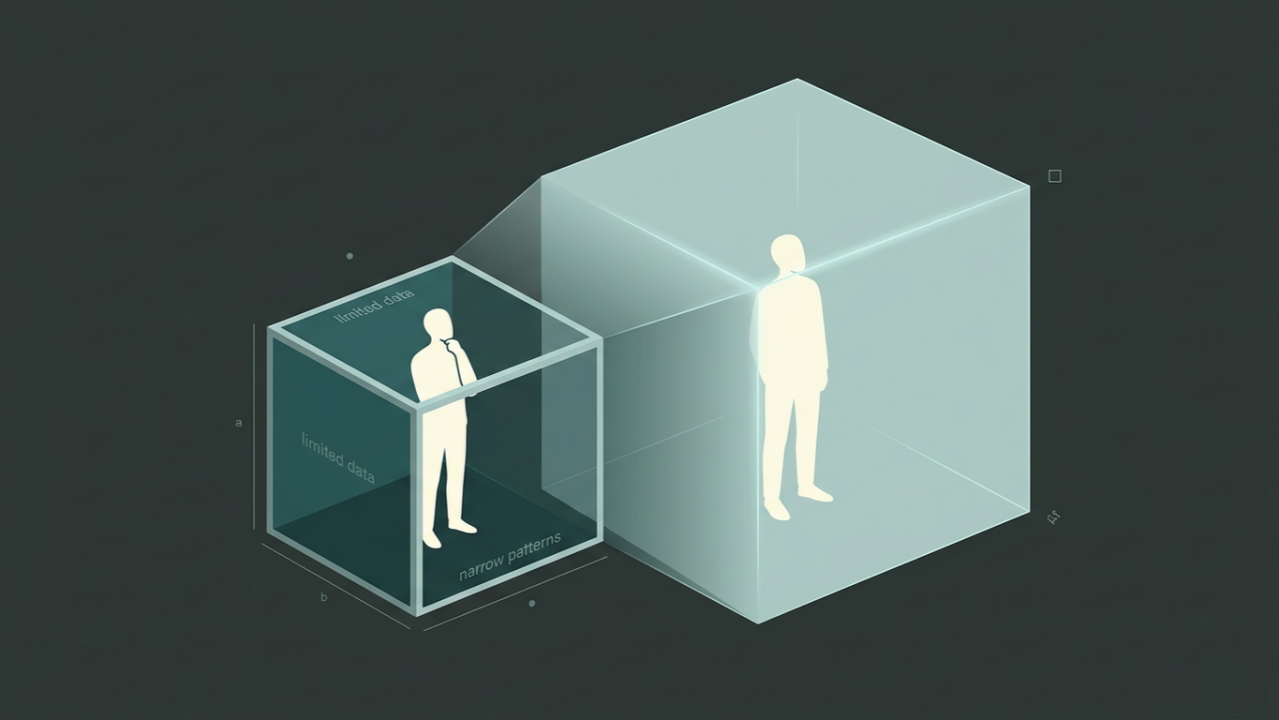
Here's what I mean. Every leader I know operates inside a box. Not a bad box, just the one defined by what you can hold in your head at once. The information you've absorbed, the patterns you've noticed, the connections you can draw in a given sitting. That box is your cognitive workspace. For most of my career, the box was whatever my brain could manage on its own. Some of us understand a single subject really well. We have a narrow but deep box. Some people, like me, have studied many different subjects, but none of them to a very extensive depth. Those people have a shallow but very wide box.
Somewhere around month six of working with AI daily, I started noticing something I couldn't explain. I was catching patterns in client conversations I would have missed before. Not because AI was whispering in my ear during those meetings. Because the way I processed information had shifted. I was holding more variables. Connecting dots across industries I'd worked in decades apart. Seeing the structural similarities between a robotics company's go-to-market failure and an accounting firm's pricing problem.
The thinking was still mine. But the box I was thinking inside had grown. I had become deeper and even wider.
The science
I ask my friend, Brad Oates, "Has AI changed your brain?" We work together on AI-enhanced corporate governance solutions together, and I expected him to brush off the question and move on. Instead, he paused to think long, and answered, "AI has made me think better". Brad then went looking for the science, as he is a continual learner.
What he came back with changed how I talk about AI.
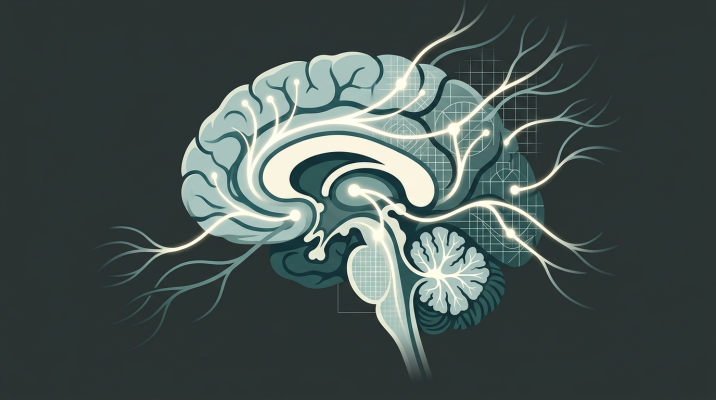
Neuroscience has a term for what I was describing: neuroplasticity (popularized by Carol Dweck in her book "Mindset: The New Psychology of Success"). The brain reorganizes itself by forming new neural connections in response to consistent stimuli. Recent research suggests that working with AI creates the kind of consistent, novel stimuli that triggers this rewiring.
Brad dug into a 2025 MIT study that found users who frequently interact with large language models show brain activity patterns that increasingly resemble the probabilistic reasoning the AI uses. The brain isn't copying the machine. It's adapting its own language and logic processing to work with more efficient patterns.
Then there's a Stanford study from early 2026 that tracked what happens when AI handles the data-heavy lifting.
When the machine takes on the low-level crunching, the human prefrontal cortex gets freed up for higher-order synthesis. Expert AI users in the study developed faster "scene-to-scene" transition speeds in their internal reasoning. They recognized abstract patterns across different domains more quickly than people who didn't use AI regularly.
Brad put a name to what we were seeing:
Transferred learning
Think about chess grandmasters who trained with computers in the 1990s and 2000s. They didn't become weaker players because a machine could beat them. They learned to see the board in patterns rather than individual pieces. They internalized the computer's way of evaluating positions. When they sat down without a computer, they were measurably better than before.
That's transferred learning. And it may be what's happening with AI and executive decision-making right now.
The dark side
Here's where I have to be honest, because this story has a dark side.
The scientific community is equally concerned about what Harvard researchers have called cognitive atrophy. If you use AI to find the pattern for you, if you skip the thinking and just accept the output, the neural pathways responsible for independent pattern recognition may weaken over time.
There's also a risk Brad and I find worth flagging for leaders: standardization of thought. When you train your brain to recognize only the most statistically probable patterns (which is what AI optimizes for), you may stop looking for the outliers. The weird connections. The insights that come from left field and change everything.
The crutch effect is real. And the executives I work with are already splitting into two camps:
- Some use AI to genuinely think differently. They ask harder questions. They explore scenarios they wouldn't have considered on their own. They pressure-test assumptions against broader data and come out with sharper judgment. They ask AI to give them multiple options and pick from the best options. They ask AI to compare and contrast choices that they have for a specific decision.
- Others use AI to avoid thinking altogether. They paste a problem in, accept the first response, and move on.
Same tool. Opposite trajectory.

The verdict
The research Brad found confirms what we've been observing with clients. Whether AI makes you cognitively stronger or weaker depends almost entirely on one variable: how you use it.
The real question
If you're rolling AI out across your firm, you're not just making a technology decision. You're making a cognitive development decision for every person on your team. The tools they use and how they use them will physically shape how their brains process information going forward.
That's not a metaphor. It's neuroscience. It's also Human-Centered AI.
So the question for every leader isn't "should we adopt AI?" That ship sailed. The question is: are we building habits that expand how our people think, or habits that let them stop thinking?
The box is bigger now. Whether you grow to fill it is up to you.

— Co-authored with Brad Oates, Chairman of Stone Advisors and co-creator of the SIQ Method for modern corporate governance.
Originally published by Brad Bush on LinkedIn.
Want a copy to keep or share?
Get this essay as a PDF you can save or send to colleagues.